
Weight Loss

All Treatments
Resources


All Treatments
Weight Loss Treatments
Tirzepatide
Semaglutide
Wegovy Pill
Resources
Healthi App
Blog
Member Meetings
Recipes
Podcast
Patient Sign in



Starting a GLP-1 medication can be life-changing for appetite control and weight loss, but it often comes with unexpected side effects like nausea or feeling overly full. With the right strategies, you can manage these sensations, stay consistent, and keep enjoying meals without stress.
Week two of a dose escalation: you injected Sunday evening and Tuesday morning you still can't finish breakfast. The coffee you had before eating made it worse. Most patients in this window assume something has gone wrong - they haven't. Nausea affects roughly 40 to 44% of patients in the major GLP-1 trials (STEP 1 for semaglutide, SURMOUNT-1 for tirzepatide at higher doses), and it's a predictable feature of slowed gastric emptying, not a signal the medication is working against you. There are eight things that make this phase shorter. For a full overview of what to expect, see our complete GLP-1 side effects guide.
These are the approaches we recommend most at HealthiCare across dose escalation periods - sorted by practical impact, not by how easy they are to hear.

The most reliable nausea trigger on a GLP-1 isn't spice or coffee - it's fat, because high-fat foods sit in a slowed stomach the longest. Bacon and sausage before 8am is the most commonly cited trigger in our patient community. The reason isn't the protein in those foods; it's the fat load arriving in a gut that's already running at a fraction of its usual speed.
If you're in your first dose escalation week and everything you eat is triggering nausea, eliminate high-fat foods for 48 hours before drawing any conclusions about the medication. That one change resolves it for most patients in that window.
Other categories to watch: heavily spiced foods, carbonated drinks, alcohol, and foods high in simple sugar. We'll be honest about something - the specific food trigger pattern varies enough between patients that some trial and error is unavoidable. High fat is the most common culprit by far, but some HealthiCare patients find carbonated drinks are their specific issue while fatty foods barely register. The pattern usually becomes clear within the first two or three weeks of paying attention.
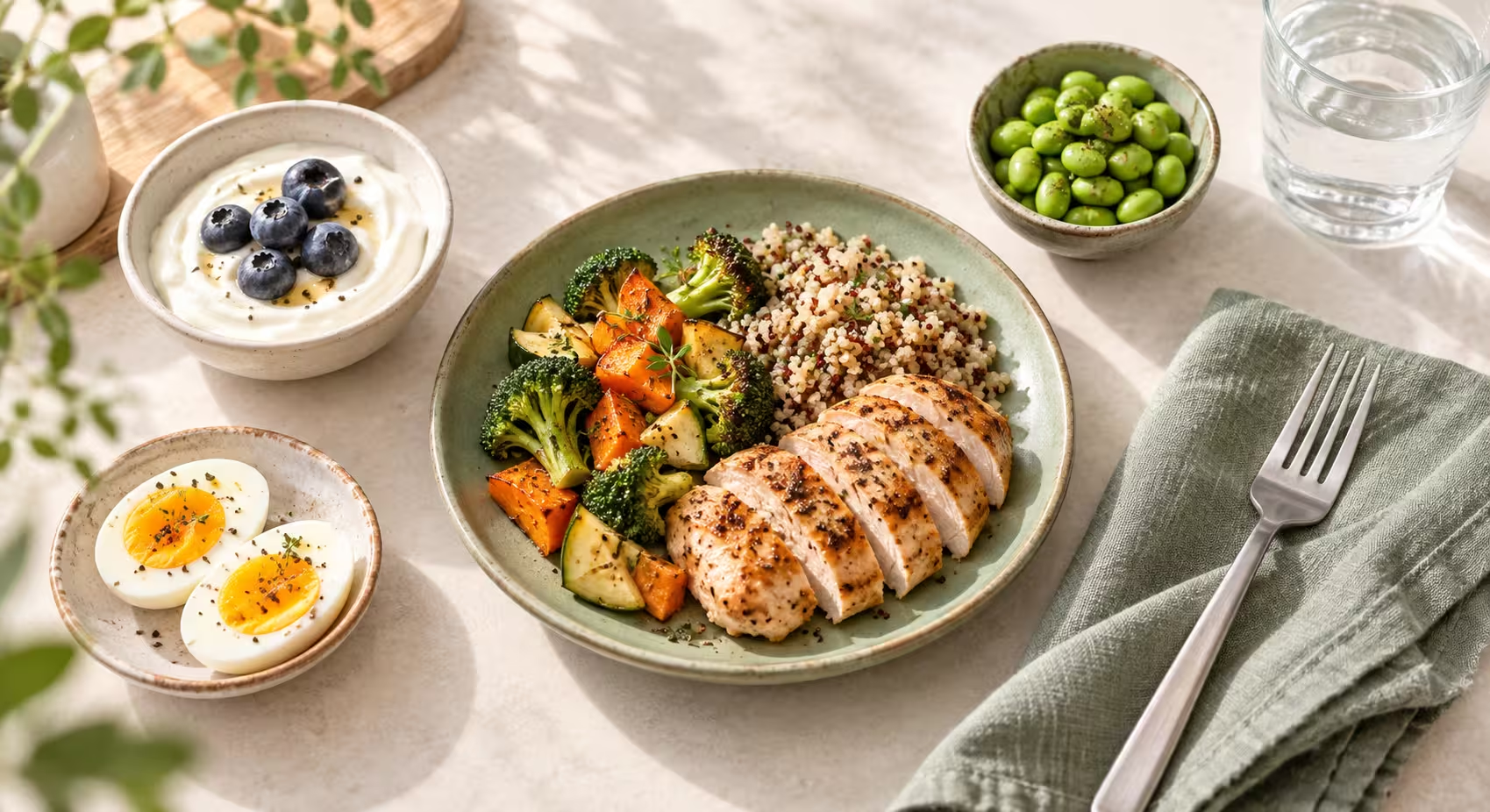
The categories that tolerate best during dose escalation are lean proteins and bland starches:
Beyond those two categories, cooked vegetables move through a slowed gut faster than raw ones, and cold or room-temperature foods tend to sit easier than hot meals - not because of the temperature, but because cold foods tend to be lower in fat and less aromatic. Most HealthiCare patients are eating close to their normal food range by month two at a stable dose.
Bedtime dosing costs nothing to try and helps enough patients that it should come before any conversation about requesting a dose reduction. Peak drug concentration arrives roughly 8 to 12 hours after injection, which puts the worst window during sleep rather than the middle of the day. Try it for three injection cycles before deciding it isn't working.
Semaglutide and tirzepatide have different pharmacokinetic profiles, and the timing shift matters more for one than the other. Tirzepatide peaks earlier and more sharply after injection, which makes the bedtime adjustment more noticeably effective. Semaglutide builds to a steadier level over a longer period - its half-life is roughly one week - so injection timing matters somewhat less, though bedtime dosing still helps some patients.
Our actual recommendation on timing: pick bedtime or morning and stay consistent for at least three injection cycles before drawing conclusions. Change one variable at a time. Patients who adjust timing and diet at the same time have no idea what helped when things improve. If shifting to bedtime produces no improvement within those cycles, the variable driving the nausea is almost certainly food or portion size - and those are the two worth addressing first anyway.

Learn more about personalized tirzepatide.
The mechanism behind GLP-1 nausea has two separate paths, which is why food changes help most patients but don't fully resolve nausea for everyone. The first path runs through the stomach: GLP-1 receptors slow gastric emptying considerably - food that normally clears in 3 to 4 hours takes longer - and nausea arrives when the slowed gut runs into more fat or volume than it can move through comfortably. The second is more direct: GLP-1 receptors also exist in the area postrema, the brain region that controls the vomiting reflex, so the medication acts on nausea at the source rather than only as a downstream consequence of a full stomach.
Most patients describing their worst nausea are in a dose escalation week, not at a stable dose. The two situations have different causes. At a new dose, the body simply hasn't adapted to the new concentration yet - that fades. When nausea appears at a dose that hasn't changed, something in food, timing, or portion size is usually driving it.
Early satiety - that full-after-two-bites sensation - runs through the same pathway as nausea. The stomach signals satiety earlier when it's processing food more slowly. That's useful for weight loss and genuinely disorienting when you're trying to hit a protein target to protect muscle mass.
We'd be overstating things if we implied this adjusts on a clean schedule. Four to six weeks is the average. Some patients, particularly at higher tirzepatide doses, take 3 to 4 months to fully settle, and a small group remains uncomfortable at the maximum dose regardless of food changes - worth bringing to whoever manages the medication rather than treating as a tolerance problem to push through.
The strategies above resolve most GLP-1 nausea without clinical intervention, but there's a short list of situations where waiting isn't the right call:
Dose reductions are a common and reasonable part of GLP-1 treatment. Many HealthiCare patients stay at a lower maintenance dose rather than pushing to the maximum, and that's a workable outcome. A dose someone can tolerate consistently for two years produces more results than a higher dose that gets abandoned in month three - and the 2025 cohort data on GLP-1 discontinuation, which puts one-year dropout at 46.5% among 125,474 adults, suggests tolerability issues are ending a lot of treatment courses that didn't have to end.

HealthiCare built Healthi Fresh specifically because the food approach that works on GLP-1 therapy is different from general healthy eating advice - portion sizes and protein priorities are built in, as are the food tolerances that shift during dose escalation. It's inside the Healthi app alongside the live member meetings where our coaches field exactly these kinds of questions in real time from patients going through the same adjustment windows.
What we address directly is the nutrition and habit side: what to eat and when, and how to rebuild routines that hold up when appetite has mostly disappeared. The medication decisions - whether to reduce a dose, what to do if nausea isn't improving - those belong with whoever prescribed the medication. The nutrition side and the medication side need to run in parallel. Patients who manage them separately tend to make simultaneous changes when something goes wrong, and then have no idea what actually fixed it.
One thing worth stating directly: if you've tried the food changes, the timing shift, the portion reductions, and bedtime dosing for 4 to 6 weeks and nausea is still disrupting your ability to eat enough protein - that's a dose conversation, not a willpower conversation. The point at which a dose's side effects outweigh its benefits is individual, and it doesn't always line up with the labeled maximum. Most patients who are struggling at the top of the escalation protocol don't need more time at that dose. They need a recalibration.
Dose escalation nausea typically peaks within 48 to 72 hours of a new injection at a higher dose and eases over one to two weeks as the body adapts. The full escalation protocol from starting dose to maintenance typically spans 4 to 6 months. Nausea that hasn't eased after 4 to 6 weeks at an unchanged dose is worth a direct conversation with a prescriber - it usually points to a food trigger or a dose adjustment, not simply more waiting.
Yes, in a narrow sense - it confirms the gastric emptying effect is active, but a fair number of patients on effective doses have minimal nausea, particularly with tirzepatide at lower doses, and that doesn't mean the medication isn't working. Nausea tolerance is not a reliable indicator of weight loss outcomes. Pushing through severe nausea in the hope of better results isn't supported by the clinical data, and we'd recommend against treating nausea as a proxy for effectiveness.
Over-the-counter options like ginger and vitamin B6 are safe and commonly used. For prescription anti-nausea medications we generally recommend and do prescribe Zofran.
The trial data doesn't give a clean answer here. Nausea rates in SURMOUNT-1 for tirzepatide at higher doses (40 to 44%) run broadly similar to STEP 1 for semaglutide (44%). Individual response varies enough that this comparison doesn't hold consistently in practice - some HealthiCare patients do noticeably better on tirzepatide, others find semaglutide easier to tolerate, and the difference isn't reliably predicted by which drug is on the prescription. Both have dose-dependent nausea that increases as the dose goes up.
At HealthiCare, our philosophy is built on two core principles: First, that medication is just one piece of the puzzle; and Second, that true success comes from combining medication with a commitment to Care and a robust support system.
We believe in more than just medication - we believe in Care + Medication. Our Care Team is here to support you throughout your journey, and all HealthiCare Members have access to our team of coaches, treatment guides, live virtual member meetings, and the Healthi weight loss app, you’ll have support every step of the way. Ready to start with full clinical support behind you? Explore HealthiCare's GLP-1 weight loss treatment.
August 17, 2026
















.avif)