Weight Loss

All Treatments
Resources


All Treatments
Weight Loss Treatments
Tirzepatide
Semaglutide
Wegovy Pill
Resources
Healthi App
Blog
Member Meetings
Recipes
Podcast
Patient Sign in



GLP-1 long-term side effects explained: what multi-year trials show about digestion, gallbladder, pancreas, thyroid, and the FDA's new eye warning.
Committing to a medication you might take for years can bring up a quiet worry, even when things are going well. The scale is moving, the food noise has softened, and somewhere in the back of your mind a question keeps tapping: but what about the long run?
Most of what we know about GLP-1 long-term side effects comes from large trials that followed people for about two to four years, plus even longer real-world studies: digestive symptoms stay the most common issue, while gallbladder problems, pancreatitis, and a rare eye condition called NAION are uncommon, and questions beyond several years are still being studied.
If you're with HealthiCare, your care team can walk through how these risks apply to your own health history, as part of your weight loss treatment.

More than you might think, and less than we'd all like. The longest randomized trial of semaglutide for weight is SELECT, which followed 17,604 adults with heart disease and overweight or obesity for a median of about 3.3 years. That's a lot of people, for a long time, with careful tracking of side effects.
Real-world data adds to the picture. A Washington University study of more than 2 million U.S. veterans with diabetes followed people for about six years and compared 175 health outcomes. It found GLP-1 users had modestly lower risks of several conditions, but higher risks of pancreatitis, kidney problems, and digestive issues. Studies like this can spot patterns, but they can't fully prove cause and effect, so they're best read alongside the trials.
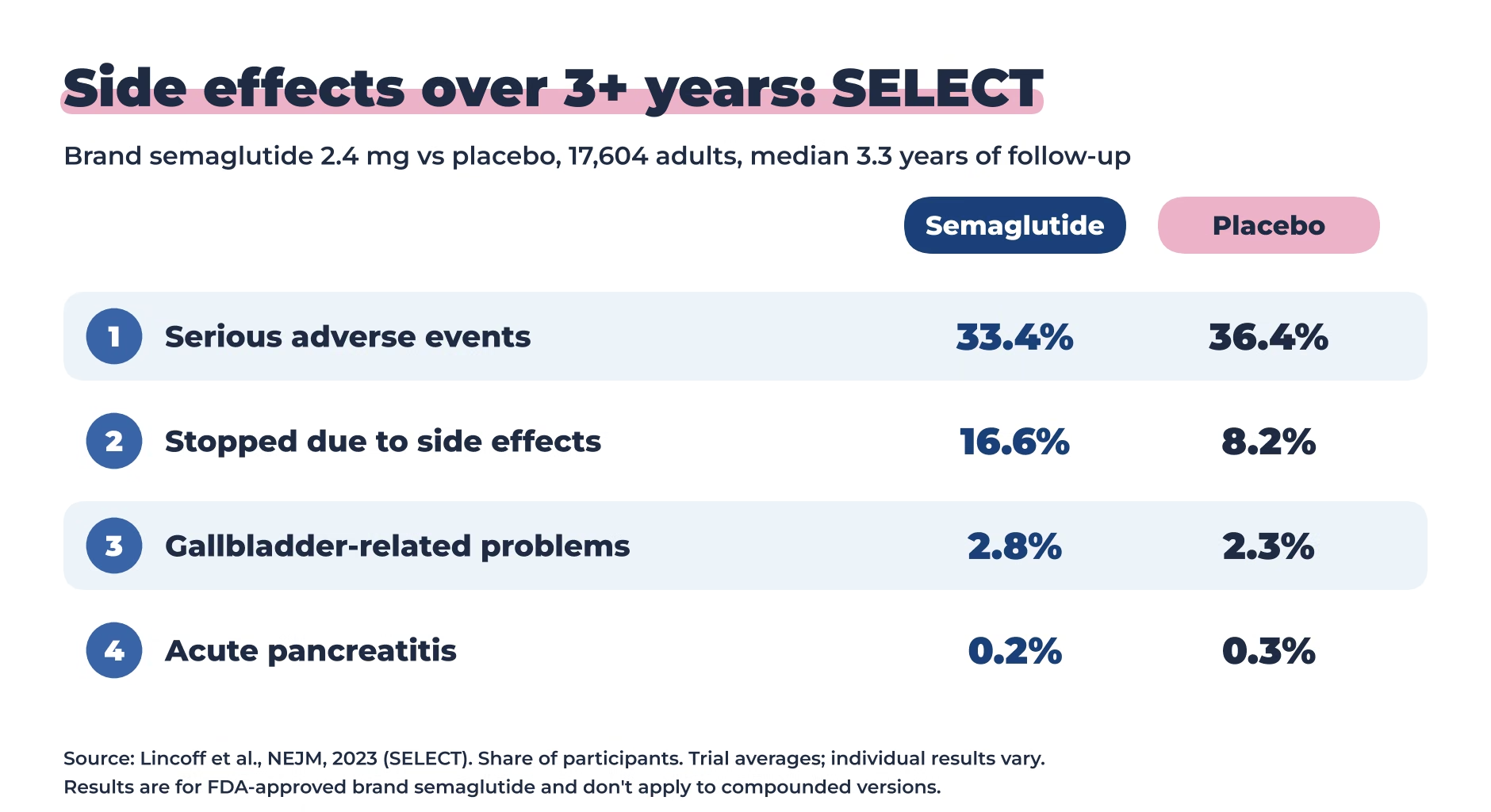
Here's the reassuring part from SELECT: serious adverse events were actually a little less common in the semaglutide group than the placebo group. That doesn't mean the medication is risk-free. It means the overall picture over a few years was steadier than some headlines suggest.
For most people, yes, at least mostly. Nausea, constipation, diarrhea, and that heavy "too full" feeling tend to show up when you start or move up a dose, then ease as your body adjusts. We cover the common ones in our guide to GLP-1 side effects and how to manage them.
Still, digestive side effects are the main reason people stop. In SELECT, about 16.6% of people on semaglutide stopped because of side effects, compared with 8.2% on placebo, and stomach-related issues were a big part of that. If you've ever felt like you're the only one struggling with it, you're very much not.
These are the risks listed on the labels, and they're worth understanding without catastrophizing.
Gallbladder. Losing weight quickly raises the risk of gallstones for anyone, with or without medication. In SELECT, gallbladder-related problems showed up in 2.8% of people on semaglutide and 2.3% on placebo. Pain in the upper right part of your belly, fever, or yellowing of your skin or eyes is a reason to call your provider promptly.
Pancreas. Pancreatitis is a listed warning for GLP-1 medicines, and the veterans study saw a higher risk with GLP-1 use. In SELECT itself, acute pancreatitis was rare in both groups (0.2% vs 0.3%). Severe stomach pain that won't go away, sometimes spreading to your back and with or without vomiting, needs medical care right away.
Thyroid. GLP-1 medicines carry a boxed warning because they caused thyroid C-cell tumors in rodents. It isn't known whether that happens in people, but the Wegovy prescribing information says not to use these medicines if you or a family member has had medullary thyroid cancer or a condition called MEN 2. A lump or swelling in your neck, trouble swallowing, or a hoarse voice that doesn't go away is worth reporting.
Reading a list like this can make your stomach do a little flip. It helps to remember that "listed on the label" means "worth watching for," not "likely to happen to you."
On November 9, 2026, the FDA announced that all GLP-1 medicines, including semaglutide and tirzepatide, will carry a warning about a possible increased risk of NAION, a rare condition that affects blood flow to the optic nerve. In the FDA's review of 126 trials, it occurred at about 6.4 cases per 100,000 person-years with GLP-1s versus 3.8 with comparison treatments. That's uncommon, and the FDA describes it as a potential risk rather than a proven one.
What matters most is knowing the signs. Sudden, painless vision loss in one eye (sometimes noticed on waking), a new blind spot, or blurry or dim central vision means contacting a healthcare professional right away.
Some of what people worry about long term isn't a side effect of the drug itself so much as a side effect of losing a lot of weight. When weight comes off, some muscle comes with it, and that matters more as we age. Strength training and enough protein can help protect it, which is why we're big fans of strength training on a GLP-1.
The changes people call "Ozempic face" are similar: when fat in the face shrinks, skin can look looser or more hollow. It's a cosmetic change, not a dangerous one, though it's understandable to have feelings about it. Our post on loose skin after weight loss on a GLP-1 goes deeper.
This might be the long-term question people ask most. When the STEP 1 trial participants stopped semaglutide, they regained about two-thirds of the weight they'd lost within a year, on average. Many of the health improvements they'd seen also drifted back.
That's not a sign of failure. It's a sign that obesity is a long-term condition, and that the medication works while you're taking it. Whether to continue, taper, or stop is a decision to make with your provider, not on your own. We've written more about what GLP-1 maintenance can look like if you're thinking ahead.

The trials above studied brand-name, FDA-approved medicines. Compounded semaglutide and tirzepatide are not FDA-approved, and they weren't part of these trials, so their long-term safety hasn't been studied in the same way. The FDA has shared its concerns about unapproved GLP-1 drugs, and the warning signs above apply no matter which version you take. That's one more reason ongoing check-ins with a licensed clinician matter.
If you'd like a refresher on the medicines themselves, Healthi's plain-language guide to GLP-1 medications is a friendly place to start.
Wanting to know what years on a medication might mean is a smart, caring thing to do for yourself. The evidence so far is fairly steady: most side effects are digestive and tend to ease, the serious risks are uncommon, and knowing the warning signs is one of the most protective things you can do. The rest is a conversation that keeps going, with research and with your care team.
If you'd like support thinking through your own risks and benefits, HealthiCare's clinicians are here to help. And if you're exploring whether a GLP-1 program could be a fit, you can start an online visit and bring every question on your list.
This article is for general information and isn't a substitute for medical advice. Never start, stop, or change a medication dose without talking to your prescriber, and seek medical care right away for the warning signs above.
The longest trials so far followed people for about two to four years and found the most common side effects were digestive, while serious problems were uncommon. Research beyond several years is still ongoing, so regular check-ins with your clinician matter.
Nausea, constipation, diarrhea, and feeling overly full are the most common. They usually show up when starting or increasing a dose and often ease over time, though they're also the main reason people stop treatment.
GLP-1 medicines caused thyroid C-cell tumors in rodents, and it isn't known whether this happens in people. They shouldn't be used if you or a family member has had medullary thyroid cancer or MEN 2. Report a neck lump, trouble swallowing, or lasting hoarseness.
In November 2026 the FDA added a warning about a possible increased risk of NAION, a rare condition affecting the optic nerve. Contact a healthcare professional right away for sudden vision loss in one eye, a new blind spot, or blurry central vision.
In the STEP 1 trial, people who stopped semaglutide regained about two-thirds of the weight they had lost within a year, on average. Talk with your provider before stopping or changing your dose.
No. The trials studied FDA-approved brand-name medicines. Compounded semaglutide and tirzepatide are not FDA-approved and haven't been studied in the same way, so ongoing care with a licensed clinician is important.
November 17, 2026