Weight Loss

All Treatments
Resources


All Treatments
Weight Loss Treatments
Tirzepatide
Semaglutide
Wegovy Pill
Resources
Healthi App
Blog
Member Meetings
Recipes
Podcast
Patient Sign in



See where to inject semaglutide or tirzepatide, how to rotate sites, and why your pen or vial instructions determine the exact technique.
HealthiCare Clinical & Editorial Team
When deciding where to inject semaglutide or tirzepatide, the usual areas are your abdomen, thigh, or the back of your upper arm. Choose an area allowed for your medication where the skin looks healthy and you can complete the injection safely. For each new dose, move to a different exact spot.
Before you begin, have three things in front of you: the pharmacy label, the instructions supplied with your pen or vial, and any directions from your prescribing care team. These tell you how to prepare, measure, store, and inject the medication you received. If they conflict or leave you unsure about a step, stop and contact your care team or dispensing pharmacy. Do not decide for yourself which source to follow.
When more than one area is allowed for your product, think about what you can see and reach, how the skin looks, and where you injected last time.
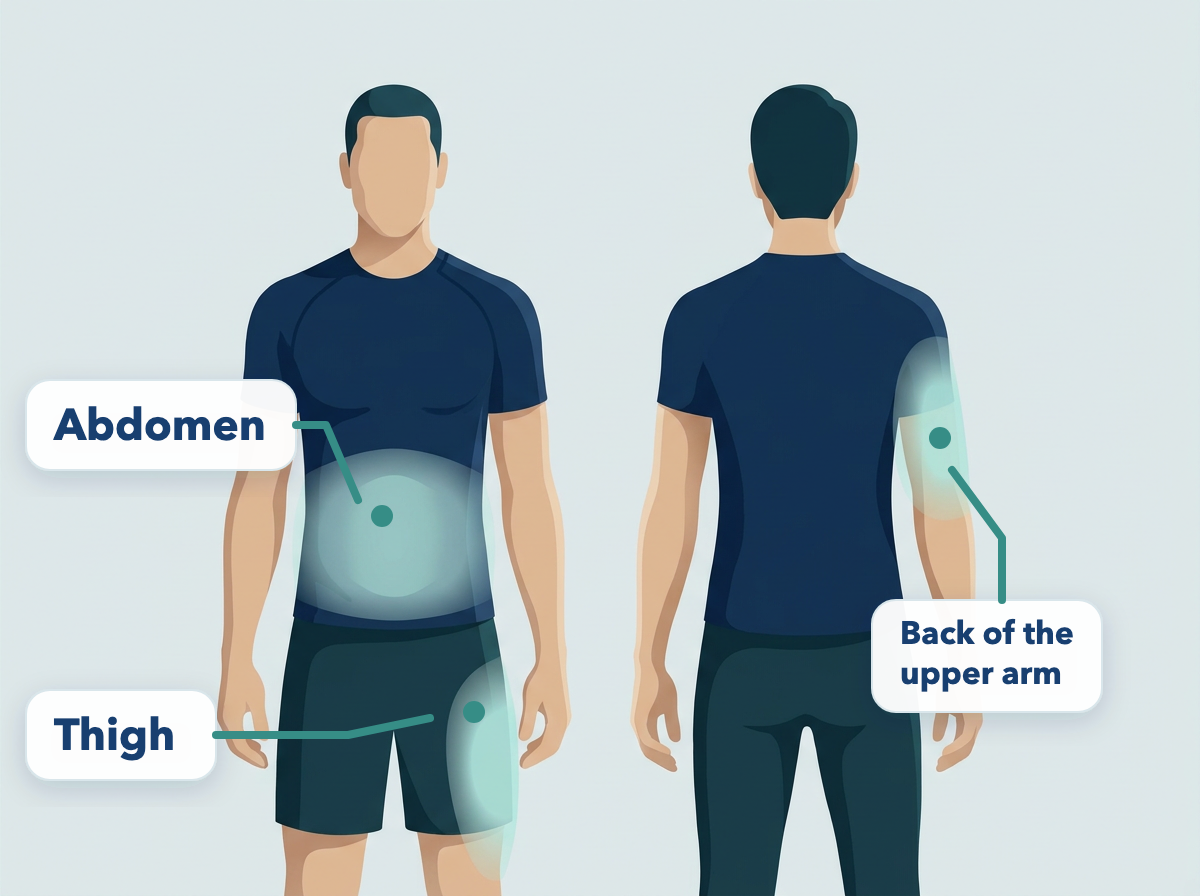
The abdomen is often easy to see and reach. Choose healthy skin within the area marked in the instructions for your product. Do not rely on a diagram or distance rule you remember from a different pen or vial.
The thigh can also be a practical choice when you give yourself the injection. Use the front or outer part designated for your product, and look at the skin before you begin.
This area can be hard to see and reach correctly on your own. Current Zepbound instructions say another person should give an upper-arm injection. Other pens or vials may have different directions, so check whether this area is available for the medication you received.
Avoid skin that is tender, bruised, red, hard, scarred, irritated, or damaged. If you cannot see or reach the chosen spot well enough to inject correctly, use another allowed area or ask someone to help when your product permits it.
There is no universal "best" site for weight loss or medication absorption.
Current Zepbound labeling reports similar tirzepatide exposure after injections in the abdomen, thigh, or upper arm. MedlinePlus semaglutide injection guidance also lists these three areas without naming one as better for weight loss. That guidance does not mean every semaglutide brand or formulation has identical directions.
The better practical choice is healthy skin in an allowed area that you can use correctly. Once you have chosen the area, move away from the exact spot used for your previous dose.
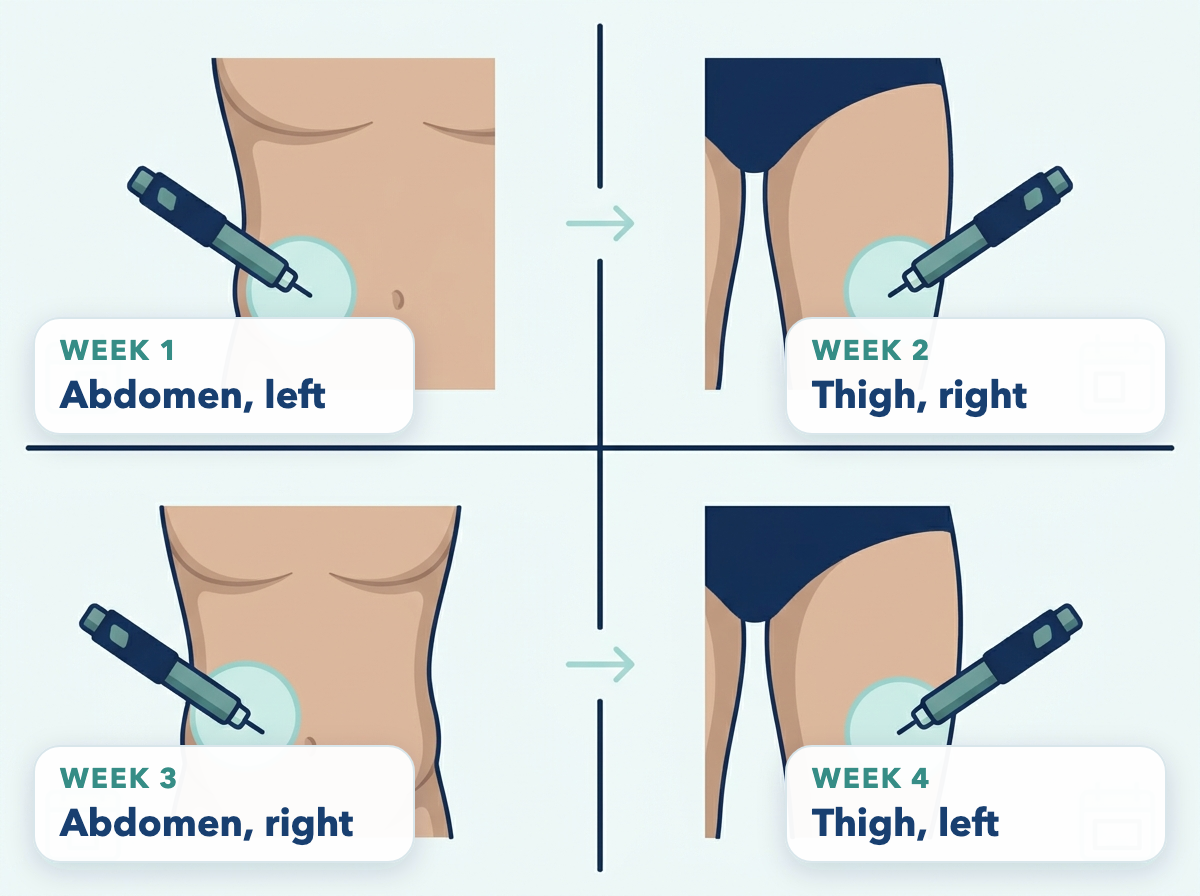
Your abdomen is an area. The place where the needle enters is the spot.
You may be able to use the same general area for another weekly dose while choosing a different spot within it. Rotation does not always mean switching from your abdomen to your thigh. Its purpose is to keep you from using the same point repeatedly.
A short note on your phone or calendar can make the next choice easier:
This is an example, not a required schedule. Before each dose, check your note and look at the skin. Recording the area and side is usually enough to help you choose a new spot.
Tirzepatide and semaglutide come in different pens and vials. The supplies and steps for a single-dose pen, multi-dose pen, single-dose vial, or vial intended for more than one dose may not be the same.
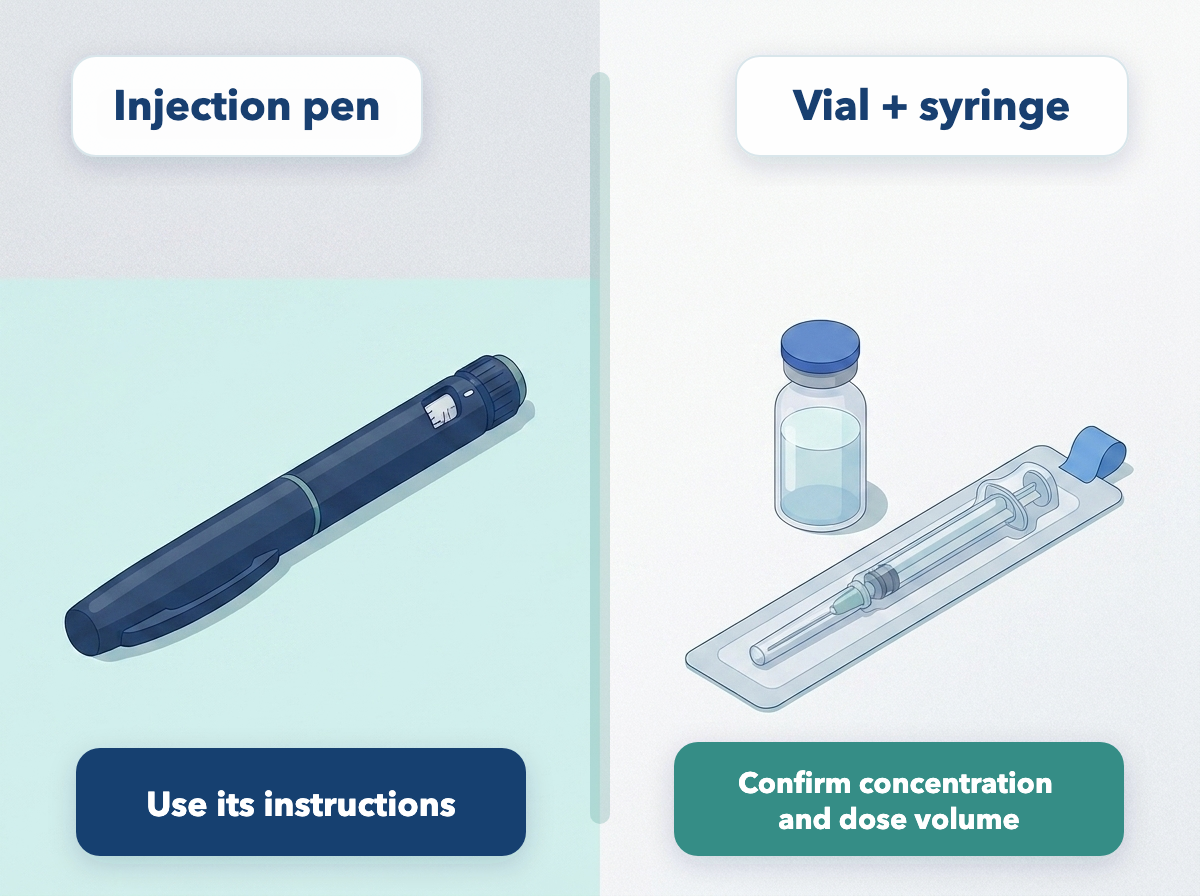
Before preparing the dose:
1. Identify the exact pen or vial you received.
2. Confirm the medication name, prescribed dose, and expiration or beyond-use date.
3. If you have a vial, confirm the concentration and dose volume written on the label.
4. Gather the supplies required for that pen or vial.
5. Check the storage directions for your medication.
6. Choose healthy skin in an allowed area, away from your last injection spot.
7. Follow the preparation and injection steps in the order provided.
8. Place used needles and syringes in an appropriate sharps container and follow local disposal rules. Never put loose needles in household trash or recycling.
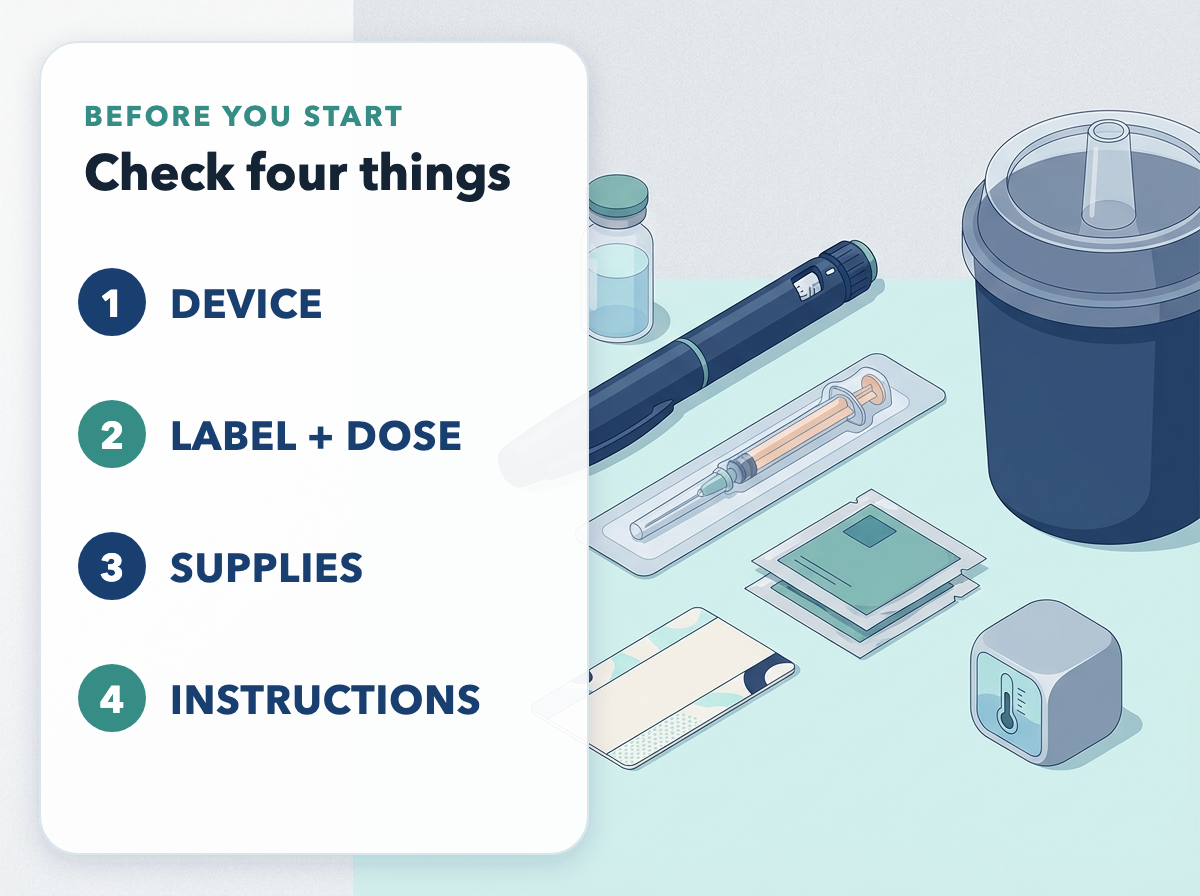
Do not borrow a step from an earlier prescription or someone else's routine. There is no single vial procedure, needle angle, skin-pinch rule, warm-up rule, or storage direction that works for every pen or vial. Use a new needle and syringe when the dose requires them, and never share injection supplies.
The markings on a syringe measure volume. They only correspond to a milligram dose when you know the exact concentration in the vial and the scale of the syringe.
A milligram dose on its own is not enough to calculate syringe units. Do not use a generic conversion chart or copy another patient's syringe amount. Use the dose volume provided for your current prescription. If the concentration, volume, or syringe scale is unclear, ask your care team or dispensing pharmacy before drawing up the medication.
Do not guess your way through an unclear step. Pause if you cannot confirm the medication, prescribed dose, concentration, dose volume, or which directions belong to the pen or vial in front of you.
The same applies when a label is difficult to read, the supplies are not what you expected, or you are unsure how the medication was stored. Old instructions and general online tutorials cannot resolve a mismatch with your current prescription.
HealthiCare patients can send a question through the HealthiCare support platform. If you are not a HealthiCare patient, contact the clinician who prescribed the medication or the pharmacy that dispensed it.
Do not automatically repeat an injection if medication leaks, the needle moves, you notice an air bubble, or you cannot tell how much medication was delivered. Another dose could give you too much medication.
Write down:
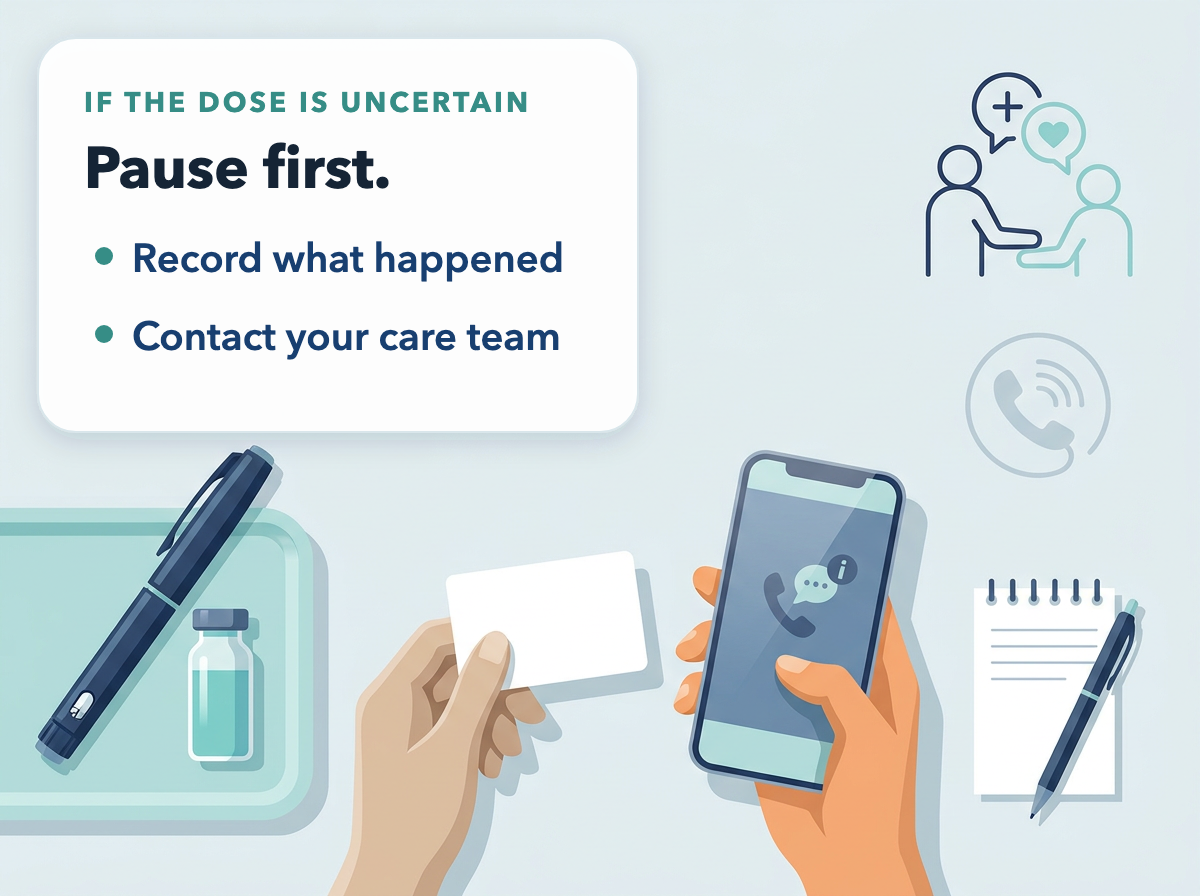
Give these details to your care team or dispensing pharmacy. They can advise you about monitoring, the next dose, and whether you need medical care. Contact your care team if an injection-site reaction becomes worse, unusually painful, or concerning.
Seek urgent medical help for signs of a serious allergic reaction, including trouble breathing or swelling of the face, lips, tongue, or throat. Follow the emergency directions supplied with your medication.
No area is identified as more effective. Current Zepbound labeling reports similar tirzepatide exposure after injections in the abdomen, thigh, or upper arm.
MedlinePlus semaglutide injection guidance lists the abdomen, thigh, and upper arm without naming one as better for weight loss. Directions may differ by brand or formulation.
The back of the upper arm is allowed for some products. Current Zepbound instructions say another person should give an upper-arm injection.
You may be able to use your abdomen each week. Choose a different exact spot for every dose and stay within the boundaries given for your product.
A milligram dose cannot determine syringe units by itself. You also need the vial concentration and syringe scale. If either is unclear, stop before injecting.
Do not automatically repeat the dose. Record what happened and contact your care team or dispensing pharmacy.
Contact them when your dose or directions are unclear, delivery may have been incomplete, or an injection-site reaction is getting worse or concerns you. Seek urgent help for signs of a serious allergic reaction.
HealthiCare patients can send a question and the details from their label through the HealthiCare support platform. If you are considering GLP-1 treatment, you can also review HealthiCare's weight-loss treatment options.
September 10, 2026















.avif)